How Video Surveys Turn Flat Data into Actionable Executive Evidence
By Finidi Lawson · Published 19 October 2026 · 9 min read
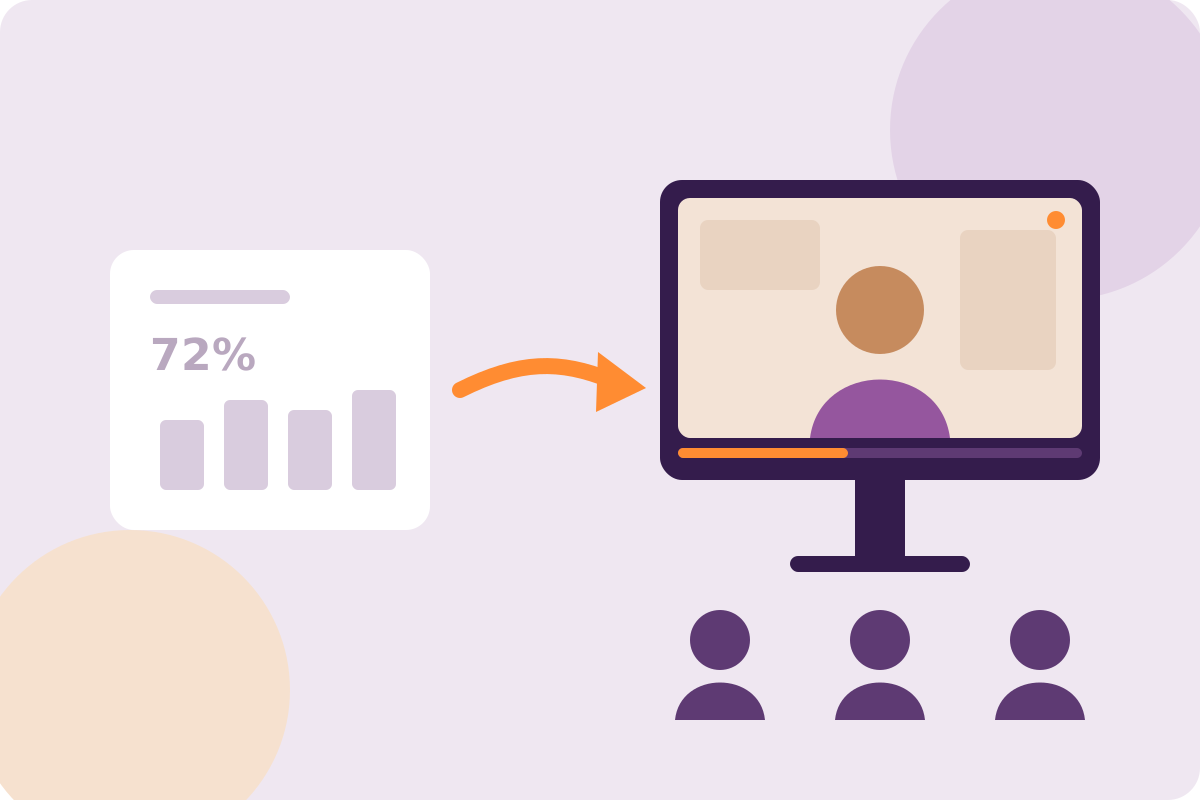
Video surveys turn flat survey data into executive evidence by pairing every number with the customer story behind it. Instead of asking leadership to trust a percentage, insights leaders can show real customers explaining, in their own words and their own world, what changed and why it matters.
Video surveys turn flat, numerical survey data into engaging human evidence, capturing the customer’s own words, world, and story that a percentage on a slide cannot show.
Executives resist static charts because a chart hides the human context they instinctively use to judge whether a finding is real or noise.
Insights leaders use video evidence to align cross-functional stakeholders around one shared, unambiguous account of what customers actually said and meant.
Grounding executive presentations in customer video feedback reinforces expert judgment and repositions the insights team as a strategic advisor rather than a reporting function.
You built the deck. NPS is up two points, the brand tracker trend line is holding, and the slide looks clean. Then someone in the room asks what actually changed for customers this quarter, and the chart has no answer. That’s the moment flat data runs out of road: it tells an executive what happened, but not why it matters enough to act on.
Voxpopme is the consumer insights platform that delivers customer intelligence and supports the expert judgment of insights leaders, and this is exactly the gap video surveys close. Instead of asking executives to trust a percentage, a video survey lets them watch and hear the customer story behind every data point.
By the end of this piece, you will know how to turn your next round of flat metrics into evidence that inspires your leadership team, grounds every answer in your customers’ reality, and gives decision-makers the confidence to act.
The Limitation of Flat Data in Executive Decision-Making
Flat data is a quantitative metric stripped of the context that explains it: a percentage or score presented on its own, with no visible reason behind the movement. That absence of context is exactly what makes executives hesitate when looking at an NPS chart or a brand tracking trend. The number can shift without anyone in the room understanding what customers actually experienced.
Most survey platforms stop at this point. They produce a flat chart, hand it to the research team, and leave interpretation to a footnote. Voxpopme takes a different position in the category. Rather than stopping at collection, it turns video-first customer evidence into customer intelligence a research team can use in the boardroom. Video research at scale is rigorous enough to survive cross-examination, and influential enough to actually change what leadership decides to do next.
Why Static Charts Fail to Create Boardroom Conviction
Static charts fail to create boardroom conviction because they present a conclusion without the proof a skeptical executive needs to accept it. A chart showing satisfaction at 72% invites the obvious follow-up: 72% of whom, saying what, and how confident are we in that number? Without an answer, the room debates methodology instead of deciding, and the meeting ends with more questions than actions.
This tracks with what the 2026 GRIT Insights Practice Report found across the research industry: 40% of researchers still rank data quality as their top challenge, even as pressure to move faster increases. A chart alone cannot resolve that kind of doubt. A customer’s own recorded voice, saying what they meant in their own words, can.
The Risk of Misinterpreting Quantitative Survey Metrics
Misinterpreting a quantitative metric usually occurs when a team assumes correlation without checking the underlying human reason. A drop in a satisfaction score could mean product quality slipped, or it could mean a sampling shift, a seasonal dip, or one vocal segment skewing the average. Flat data cannot tell these apart on its own, and an insights leader who presents a number without that context is exposed the moment an executive pushes back.
How Video Surveys Humanize Consumer Research for the C-Suite
Enterprise video surveys humanize consumer research by pairing numerical findings with visual and vocal evidence that conveys what a customer actually meant. A score tells an executive what customers reported, while a video shows the person, the place, and the story behind the answer, which is often what the decision actually turns on.
Seeing the Customer’s World: Context a Score Can’t Carry
Watching a customer answer adds context that a transcript or a score can’t carry. A written response records what someone said, while video lets a research team see where the customer is, hear how they explain things in their own words, and follow the story that led to their answer. When a customer describes a recurring frustration from their own kitchen, including the part of the routine that causes it, they show stakeholders the circumstances around a finding, as well as the finding itself.
That context serves researchers and stakeholders differently. For the insights team, it helps interpret what a response means in the life of the person giving it. For an executive, it makes the people behind a metric easier to understand and harder to dismiss. A single clip still isn’t representative on its own. The analysis establishes how widespread a pattern is, and the customer’s account shows what that pattern looks like in someone’s actual day.
How Do Video Surveys Convert Quantitative Metrics into Qualitative Proof?
Video surveys convert a quantitative metric into qualitative proof by attaching a real customer’s story to the number, so the finding is no longer just an assertion. Instead of reporting that satisfaction dropped by three points, an insights leader can show the executive team three customers explaining exactly what changed in short self-recorded videos. The number sets the scale of the issue. The video proves it happened.
Validating Statistical Anomalies with Authentic Human Context
An unexpected spike or dip in survey data is only useful once someone can explain it, and video survey responses are the fastest way to check whether an anomaly reflects a real shift or a sampling quirk. Reviewing a handful of video responses tied to the anomalous segment lets a research team confirm or rule out a theory in the room, rather than defending an assumption they cannot back up.
The same applies when what customers say and what they do don’t match. Voxpopme’s State of Insights 2026: Insiders Edition, a study of 126 insights practitioners run with MRII, found that 21% of teams saw a stated-intent finding contradicted by actual customer behavior in the past year. Yet only 11% use video-based evidence to check what people say against what they do.
Building Executive Decision Confidence with Video Surveys
Building executive decision confidence requires presenting multidimensional evidence that grounds insights in the customer’s reality and holds up when senior executives seek to go beyond a single chart. Video survey evidence gives insights leaders a second layer of proof that sits underneath every number they bring into the room.
It’s also the problem insights leaders most want solved. In the same State of Insights 2026 report, proving the business impact of insights ranked as the number-one priority for the next 12 months, ahead of every AI-specific concern.
1. Replacing Assumptions with Verified Customer Truth
An assumption is a gap an executive will eventually find and question. Verified customer truth, a customer saying something on camera in their own words, closes that gap before the question gets asked. This is the difference between an insights team that reports what customers said and one that proves it.
2. Aligning Cross-Functional Stakeholders Around Shared Evidence
When marketing, product, and finance each interpret the same chart differently, alignment stalls. A shared video clip removes that ambiguity because everyone in the room heard the same customer say the same thing, in their own words, at the same time. Disagreement moves from “what does this number mean?” to “what should we do about it?”, which is a faster and more productive argument.
3. Supporting Expert Judgment with Unassailable Proof
Supporting the expert judgment of insights leaders is where this principle matters most. AI Insights and AI Moderator surface actionable intelligence and narrow down which clips and patterns are worth an executive’s attention. Expert judgment determines what those patterns mean for the business and what should happen next. The technology narrows the field. The insights leader still makes the call, and video evidence lets them make it with proof in hand rather than a hunch.
Why Do C-Suite Executives Trust Video Feedback Over Slide Decks?
C-suite executives trust video feedback over slide decks because direct human testimony removes ambiguity and validates the research methodology behind a finding in a way a chart cannot. A slide asks an executive to take a research team’s word for what a number means. A video lets the executive judge the evidence themselves, in real time, using the same instincts they would use in any other conversation.
This is also a risk-management decision. Executives who greenlight a strategic shift are personally exposed if the underlying research proves thin. Watching real customers reduces that exposure because the executive sees the evidence directly rather than relying entirely on someone else’s summary.
Frequently Asked Questions About Video Surveys and Executive Alignment
What is flat data in market research?
Flat data refers to isolated numerical outputs, such as percentages or NPS scores, presented without the qualitative context that explains what drove them. It tells the reader what happened but not why, which is exactly the gap that makes executives hesitate before acting. Voxpopme’s consumer insights platform pairs these metrics with video evidence so the “why” travels with the number instead of getting lost in a footnote.
Why do static charts fail to persuade C-suite leaders?
Static charts fail to persuade because they invite debate over assumptions instead of building shared understanding. An executive looking at a chart has to take the underlying interpretation on faith. Watching a real customer explain their experience creates instant alignment because everyone in the room reacts to the same direct evidence rather than someone else’s summary.
How do video surveys enhance executive influence?
Video surveys enhance executive influence by giving insights leaders a highlight reel that illustrates the core conclusion of a study rather than just asserting it. That reel lets a research director lead a strategy discussion from a position of proof, walking executives through the evidence directly instead of defending a chart line by line under questioning.
What do video surveys capture that text responses miss?
Video surveys capture the customer’s own words, how they explain their thinking, and the setting they’re in, such as the kitchen, store, or commute where the experience actually happens. A text-based open-end omits all of that. Seeing and hearing the person helps researchers interpret what an answer means in the respondent’s life, and helps stakeholders connect with the people behind a metric.
Conclusion
Flat data can tell an executive what moved. It cannot tell them why it matters or what to do next, and that gap is where good decisions stall. Video surveys close it by pairing every metric with the authentic human evidence needed to earn senior conviction. Voxpopme is the consumer insights platform that delivers customer intelligence and supports the expert judgment of insights leaders, turning flat metrics into evidence a boardroom can act on with confidence.
Stop presenting flat data. Discover how Voxpopme video surveys support expert judgment and drive executive action.
Share this post