The Enterprise Buyer’s Guide to Video Surveys: Turning Customer Truth into Executive Action
What a video survey is, how to design one, and how to turn hours of footage into evidence your boardroom will act on.
By Finidi Lawson · Published 14 October 2026 · 14 min read
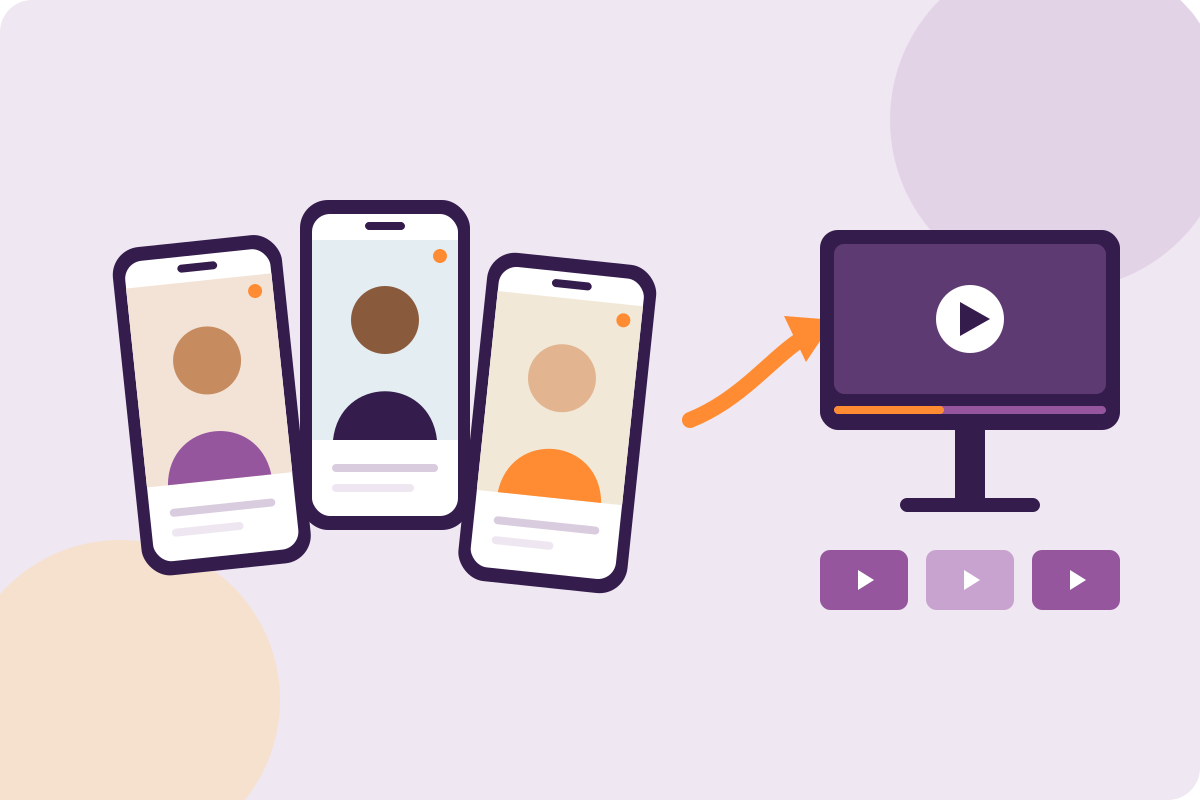
A video survey captures open-ended, on-camera responses from real customers, giving enterprise research teams the voice, emotion, and context a rating scale can never convey. Paired with AI that surfaces what matters and the expert judgment that decides what it means, video turns customer truth into evidence your executive team will act on.
A video survey captures open-ended, on-camera responses from real customers, giving enterprise research teams real stories, real people, and context that a rating scale can never convey.
A cloud-based video feedback tool gives research teams the qualitative depth needed to explain the human “why” behind the quantitative “what.”
A continuous video feedback loop keeps customer evidence flowing into product, brand, and executive decisions instead of sitting in a single project report.
Modern video synthesis pairs AI that surfaces what matters in hours of footage with the expert judgment of a researcher who decides what the pattern means for the business.
Enterprise-grade video feedback platforms are versatile, supporting mixed methods and a range of use cases while building a body of research that compounds in value over time, all underpinned by the security standards even the strictest legal teams demand.
You’ve sat in the room with a deck. The deck has three bar charts and a satisfaction score. Then someone on the leadership team asks, “But why do they feel that way?” and the honest answer is: you don’t fully know. The text survey told you what happened, but it didn’t tell you what it looked like.
That’s the gap enterprise video surveys close. A video survey gives research teams human evidence a text field can’t hold. Voxpopme is a consumer insights platform that offers quality video surveys and supports insights leaders’ expert judgment, turning raw customer evidence into a format your executive team can act on.
This guide walks through what a video survey is, how the underlying platform should be built, how to write prompts that get respondents to talk honestly, how to keep that evidence flowing into the business on an ongoing basis, and how to synthesize hours of footage into something a boardroom will actually sit through. By the end, you’ll know exactly what to build, buy, or fix in your current video feedback approach.
What Is a Video Survey in Enterprise Market Research?
A video survey is an asynchronous qualitative research method in which respondents record short, open-ended video responses to specific prompts. The responses give research teams authentic voice, facial expressions, and situational context that a numeric scale cannot capture. Respondents record on their own time, on their own device, and in their own environment. That’s precisely what makes the evidence feel real rather than staged.
Basic survey plugins treat video as an optional widget bolted onto a text form. That’s a feature, not a platform. An enterprise consumer insights platform supports video response as a core unit of evidence: transcribed, tagged, searchable, and connected to every other study a team has run. While a video widget or app gives you a folder of clips, a platform gives you conclusions that are rigorous enough to survive senior scrutiny, cumulative enough to compound in value across studies, and influential enough to actually shape a decision.
That’s also where Voxpopme sits relative to the wider consumer insights category. Most other platforms in this space focus on collecting responses only. Voxpopme’s approach is built around expert judgment: the platform’s AI analytics and research agents surface the patterns in the footage, and a trained researcher decides what those patterns mean for the business.
The Qualitative Gap: Why Text Surveys Fail to Persuade Executives
Text surveys fail to persuade executives because a satisfaction score has no face attached to it, and executives make decisions based on conviction, not just data points. A number can be argued with. A customer visibly frustrated with your checkout flow is much harder to dismiss in a boardroom.
This is the specific failure mode insights leaders describe over and over: the research was technically sound, the sample was clean, the analysis was correct, but the recommendation still didn’t move. Not because the finding was wrong, but because a slide of percentages doesn’t carry the emotional weight needed to change a leadership team’s mind. Executives aren’t rejecting the data. They’re asking for evidence they can feel is true.
Video closes that gap by putting the executive in the room with the customer, even asynchronously. Video content achieves a level of engagement that static data presentations don’t, which changes how findings are communicated and understood. A showreel of five customers struggling with the same step in a product isn’t a data point anymore. It’s proof.
What Is Video Feedback Compared to Static Survey Responses?
Video feedback is a recorded, open-ended response that carries tone, facial expression, and unscripted detail. In contrast, a static survey response is a fixed answer (a rating, a checkbox, a short text field) that carries none of that context. A static response tells you a customer rated the onboarding experience a 3 out of 5. Video feedback tells you the exact moments they became confused, frustrated, or delighted, and lets you hear, in their own words, what triggered those feelings.
Static responses are efficient to collect and easy to aggregate into a chart. That’s their value, and enterprise research programs still need them for breadth and statistical confidence. Video feedback earns its place for a different reason: it’s the format that makes a finding undeniable. When your research design pairs quantitative breadth with video-based depth, you get a study that’s rigorous on the numbers and persuasive on the human truth behind them.
Video Surveys and the Say-Do Gap
What customers say and what they do often diverge. Voxpopme’s State of Insights 2026: Insiders Edition found that 21% of insights teams saw a stated-intent finding contradicted by actual customer behavior in the past 12 months. Yet only 11% currently use video-based evidence to check what people say against what they do.
Video doesn’t catch respondents out. It lets you see the behavior and ask the “why” behind the gap, in the respondent’s own words and environment.
The Architecture of a Cloud-Based Video Feedback Tool
A cloud-based video feedback tool provides secure, enterprise-grade infrastructure for capturing, analyzing, and sharing video responses across web and mobile, so research teams can run studies without managing recording hardware, storage, or transcoding themselves. The infrastructure layer is invisible when it works and catastrophic when it doesn’t. A corrupted upload or a lost consent record can compromise an entire study.
Enterprise buyers should evaluate a video feedback platform the way they’d evaluate any system that touches customer data: not just on the recording experience, but on what happens to that footage after it’s captured. Where is it stored? Who can access it? How long is it retained? Is it still searchable six months later when a different team needs it?
1. Multi-Device Recording: Mobile Video Feedback Capabilities
A mobile-friendly video experience matters because most consumers will record on their phones in the environment where the behavior actually happens, rather than sitting at a desktop for a market research task. If your platform requires a desktop browser and a webcam, you’re not researching real behavior. You’re researching who owns a webcam.
Video research platforms can deliver via an app, an optimized mobile experience, or both, allowing respondents to open a link, record directly from their phone’s camera, and submit without creating an account or downloading a separate application.
Industry platform benchmarks published in The GRIT Report reveal a clear device preference: 70% to 80% of asynchronous qualitative video responses are recorded on mobile devices. By meeting consumers on their smartphones, brands capture spontaneous, in-the-moment video insights, with desktop submissions (15% to 30%) largely reserved for complex B2B screen-sharing tasks.
2. Enterprise Security, Compliance, and Consent Management
Enterprise security, compliance, and consent management mean that the platform captures explicit respondent consent at the point of recording, encrypts video and transcript data in transit and at rest, and provides your legal and privacy teams with a clear audit trail. For enterprise buyers, this is not a nice-to-have. It’s the difference between a platform you can put in front of procurement and one you can’t.
Video carries more identifiable information than a text response: a face, a voice, sometimes a visible location. That raises the compliance bar. An enterprise platform should let you configure consent language per study, restrict who inside your organization can view raw footage versus a redacted clip, and honor deletion requests without breaking the rest of your repository. See how Voxpopme handles this on our security page.
How to Design Effective Video Surveys: Prompt Templates and Methodologies
Designing effective video surveys requires crafting open-ended prompts that encourage unscripted storytelling while still guiding the respondent toward the specific business question you need answered. A prompt that’s too open produces rambling footage with no usable signal. A prompt that’s too leading produces a scripted-sounding answer that no executive will trust.
The discipline is the same one a good interviewer uses in person: ask a question specific enough to anchor the response, and open enough to let the respondent’s experience come through.
Framing Questions That Elicit Authentic Emotion and Story
The strongest video prompts ask respondents to walk you through a specific moment rather than summarize a general opinion. “Tell me about the last time you [did the behavior]” produces a story. “What do you think about [product]?” produces a generic answer that could describe almost anything.
A few framing principles carry across most enterprise studies:
- Anchor the prompt to a real moment, not an abstract concept. “Show us where this happened” beats “describe your experience.”
- Ask for the near-miss. The moment they almost didn’t buy, almost gave up, or almost switched is where the most honest emotion lives.
- Give explicit permission to show their real environment. A respondent who feels they need to record somewhere tidy and formal will give you a tidier, more formal answer.
Enterprise Video Feedback Template Library
A reusable template library lets research teams launch a new video study in days instead of rebuilding prompt logic from scratch every time, while still adapting the wording to the product or category being tested.
Template 1: Early Product Testing and First Impressions
Ask the respondent to film themselves opening the product for the first time, narrating their reactions as they go, before you tell them anything about what it’s designed to do. Follow with a prompt asking what they expected versus what they got. This template surfaces the gap between marketing promise and lived experience before a product ever reaches the shelf.
Template 2: Brand Sentiment and Customer Journey Exploration
Ask the respondent to describe the last time they thought about your brand outside of using the product itself: an ad they saw, a conversation with a friend, a moment of frustration or loyalty. Follow with a prompt asking them to walk through their most recent purchase journey, moment by moment. This template captures brand perception in the customer’s own frame, not yours.
Template 3: In-the-Moment Product Interaction and Usage
Ask the respondent to film themselves using the product exactly as they normally would, in their normal environment, narrating what they’re doing and why. This template is the closest a video survey gets to in-home observation without a researcher physically present, and it’s especially strong for uncovering workarounds and usage patterns nobody designed for.
Building a Continuous Video Feedback Loop Across the Organization
A video feedback loop is an ongoing operational workflow that continuously channels authentic customer feedback into decision-making across marketing, product, and leadership teams, rather than producing a single report that gets read once and archived. The loop works only if the evidence keeps moving after the initial study ends.
Most enterprise research programs run studies well and distribute findings poorly. A feedback loop fixes the second half of that equation: it defines who receives what evidence, on what cadence, and in what format, so customer truth becomes a standing input to strategy rather than a one-time deliverable.
Connecting Research Teams, Brand Managers, and Product Leads
A functioning feedback loop gives brand managers and product leads direct access to relevant customer video, searchable by theme or question, not buried in a slide deck they’ll never reopen. When a product lead can search for “checkout frustration” and immediately pull the six most relevant clips from the last three studies, the research team stops being a bottleneck and becomes a resource people return to on their own.
This requires a shared repository, such as Voxpopme’s Data and Insights Repository. A folder of video files with no tagging or transcript search becomes unusable within a few studies. A searchable repository stays useful for years, because the value compounds: the tenth study benefits from everything the first nine surfaced.
Synthesizing Video Surveys Without Compromising Research Rigor
Synthesizing video surveys requires organizing raw video files into clear thematic insights and concise showreels, without losing the nuance that made the video format worth using in the first place. The risk with any large volume of qualitative video is that synthesis becomes summarization, and summarization is where nuance dies.
The fix isn’t to synthesize less. It’s to divide the work between what technology does well and what a trained researcher does well.
The Role of AI That Surfaces What Matters in Video Transcripts
AI that surfaces what matters works by transcribing hours of video, indexing it by theme and sentiment, and surfacing the moments most relevant to the researcher’s actual question, making search through raw footage more scalable than ever before. That’s the capability, not the conclusion.
Practitioners already work this way. The same report found that 51% of insights practitioners would not trust AI to run any research task fully autonomously, but with a human reviewer in the loop, 58% would trust it with open-end analysis.
Research agents like Voxpopme Compass surface the pattern. Expert judgment decides what it means for the business. A model can flag that forty respondents used a phrase like “too many steps” near the checkout stage. It cannot tell you whether that’s a UX problem, a pricing objection in disguise, or noise from a single flawed prompt. That call requires a researcher who understands the study, the category, and the business context in which the finding will land. The technology gets a researcher to the relevant footage faster, but it shouldn’t be making the call.
Creating Boardroom-Ready Video Showreels That Drive Decision Confidence
A boardroom-ready showreel is a short, tightly edited sequence of the most representative and most persuasive customer clips on a single theme, built to make a finding land in the two or three minutes a leadership team will actually give it.
The discipline in building one is ruthless selection, not comprehensive coverage. A showreel that tries to represent every nuance from every respondent becomes exactly the wall of data it was meant to replace. Three clips that unmistakably make the point beat fifteen clips that gesture at it. This is where expert judgment does its most visible work: deciding which three moments actually carry the argument.
What Is the Difference Between a Video Feedback Tool and a Creative Video Review App?
A video feedback tool built for consumer insights collects market research directly from consumers to inform business decisions. In contrast, a creative video review app, such as Dropbox Replay or Wipster, helps media and creative teams leave frame-accurate comments on a video’s editing, pacing, or production quality. The two get confused often because both involve “video” and “feedback,” but they serve different audiences with different goals.
| Evaluation Vector | Video Feedback Tool (e.g., Voxpopme) | Creative Video Review App |
|---|---|---|
| Who records or comments | Consumers and customers | Internal creative and media teams |
| Purpose | Understand what customers think, feel, and need | Review and approve video edits |
| Output | Customer intelligence, themes, and showreels for decisions | Frame-accurate notes on a cut |
Frequently Asked Questions About Enterprise Video Surveys
What is a video survey in market research?
A video survey is an asynchronous qualitative research technique where respondents record open-ended video responses to specific prompts. It captures the authentic voice, facial expressions, and situational context that a text or numeric survey response cannot convey, giving research teams direct access to how customers actually think and feel, not just what they select on a scale.
How do video surveys compare to traditional text surveys?
Text surveys capture surface-level, quantifiable metrics efficiently and at scale across large samples. Video surveys reveal the underlying human sentiment, detailed explanation, and emotional nuance behind those metrics. Neither replaces the other. The strongest enterprise research designs pair quantitative breadth with video-based depth to explain the “why” behind the “what.”
How do enterprise research teams synthesize large volumes of video feedback?
They make it searchable. Platforms like Voxpopme Compass transcribe and index every video across every study, so researchers can ask a question in plain language and instantly surface verified quotes and clips. Researchers then apply their judgment to pick the right story and build a stakeholder-ready showreel in minutes.
What makes an effective video feedback template?
An effective template opens with a warm-up question to put the respondent at ease, follows with a specific situational prompt anchored to a real moment rather than a general opinion, and explicitly permits them to show their real-world environment. Templates that ask for a story instead of an opinion consistently produce more usable, more authentic footage.
How does localized video feedback improve respondent engagement?
Tailoring video prompts to specific countries or local languages makes the question feel relevant to the respondent’s actual context rather than generic. That relevance tends to increase both completion and the authenticity of what’s captured, because respondents are answering a question that genuinely applies to their situation instead of translating a foreign frame of reference onto their own experience.
Conclusion
Text surveys tell you what customers do. Video surveys reveal why they do it, and what actually changes a decision. The value isn’t in collecting hours of raw footage; it’s in pairing AI that surfaces what matters with the expert judgment that decides what those patterns mean for your business, then presenting the result with enough conviction that your leadership team acts on it.
Transform customer truth into boardroom impact. See how Voxpopme’s enterprise video surveys support expert judgment.
Share this post